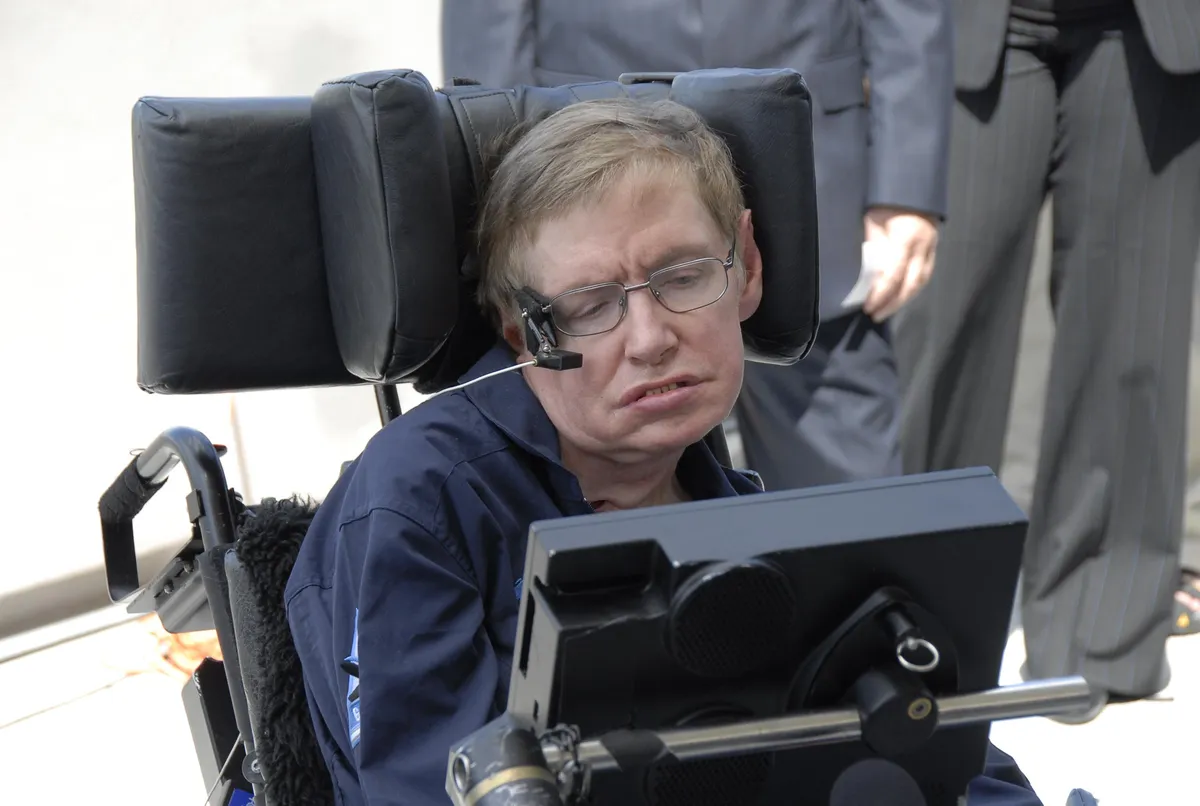
Review of Brief Answers to the Big Questions - Stephen Hawking's final book
Brief answers to the big questions is another awesome book from Stephen Hawking and also, unfortunately, his last one.
Anybody can pick this up and start reading and requires no particular knowledge of particle physics or cosmology. Hawking makes the secrets of the universe accessible to all thanks to his simple way of explaining things with enough real-world analogies. Now here are some specific things I learned or liked in the book.
⚠️ Spoiler alert ⚠️
What makes up the universe?
- Matter
- Energy
- Space
Einstein showed that matter and energy are one and the same. Only the two sides of a coin. So that leaves us with just energy and space. In order to prove that the universe came out of nothing Hawking uses this analogy:
Imagine one needs to make a hill. So one starts digging a hole somewhere and will eventually pile up all that mud to make a hill. Thus, in the process of making a hill we also made (dug) a hole. Consider that the hill represents positive energy and the hole, negative energy.
Similarly, the universe was created out of nothing. The total sum is zero. Out of nothing came a positive part and a negative part. The positive part is the matter and the energy that we see and the endless space around it is the negative half.
Everything is perfectly balanced.
But then who made the big bang happen?
Hawking says that just like in quantum mechanics where protons can come in and out of existence just like that (protons are only defined by the probability of its occurrence at a point)… So did the universe pop out… just like that… From nothing.
On black holes
Black holes are so massive and dense that they’re stars collapsing onto themselves and they’re so massive that even light cannot leave it. These massive stars have so high a gravity that their escape velocity is higher than that of the speed of light. For comparison the earth has an escape velocity of 11.2km/s while the speed of light is 300000000km/s. Due to the high gravity even light can’t escape these ‘black holes’ and gravity begins to pull all the mass inwards. The star begins to collapse onto itself leading to a gravitational collapse. It compresses and falls onto itself to form a singularity. The only points in space that don’t obey Einstein’s laws.
Hawking goes on to explain how it’s going to be when we travel into a black hole. One is going to be stretched as different parts of our body experience different gravitational forces. We get stretched length-wise and squished from the sides.
A person watching us from a distance will see us slow down near the event horizon and then hover there for a while and soon become redder and start fading until nothing of us is seen. That person will never see us cross the event horizon. Nobody ever will.
On the concept of time and the existence of God
Time slows down as one begins to enter a black hole and within it… Time fully stops. i.e time ceases to exist within black holes. So if we consider the big bang to have happened from an infinitesimally small and infinitesimally dense substance ; imagine the analogy with a black hole - so time did not exist then.
Hence, Hawking argues that no divine force created the universe as time itself didn’t exist for God to create the universe. So whenever someone asked him if God created the universe? He would say that, before the big bang there was no time for God to create the universe. And hence the question doesn’t make any sense. He compares that question akin to asking directions to the edge of the earth. The earth’s a sphere it has no edge.
On time travel:
To travel in time one needs to travel faster than the speed of light. Einstein showed that as a rocket approached the speed of light the energy needed to increase the velocity any further keeps on rising sharply. i.e we need infinite energy to accelerate a rocket beyond the speed of light. Thus making it very hard to travel back in time. One other possibility of traveling large distances in no time is by warping space time so much that one can reach the other side of the galaxy in a jiffy - a wormhole sort of thing.
Some other random and interesting things in the book:
- The dark sky at night is itself proof that the universe had a beginning. If at all it had been in existence for infinite time and space, any line of sight would have ended up on a star and all these stars together would have heated up the universe high enough to make everything burn.
- A brief explanation of the theory of multiple histories proposed by Richard Feynman.
- That Multiple histories theory + Einstein’s theory = The Unified theory (aka the Holy Grail of cosmology)
- One out of five stars have planets like earth revolving around it. So all those could possibly have intelligent life.
- Self designed evolution with technology like CRISPR will lead to the birth of superhumans in labs that go against all moral and ethical values to edit the human genome.
- We humans are ultimately chemical based. It’s the tiny molecules that make us who we are and humans can’t survive a trip to a star due to the large travel time
- In the 4th chapter Hawking gives a good summary of the transition from classical physics and a deterministic world proposed by Laplace to quantum physics and the uncertainty principle of Heisenberg.
- The Doomsday clock - More info here
- The biggest threats that the human race faces include another asteroid collision or a nuclear war. While reading this book I was also watching this series called Chernobyl that is all about the incidents that lead to the nuclear catastrophe and its aftermath.
- Hawking suggests leaving the planet as soon as possible and exploring other planets for settlement. “Humans should not have all their eggs in one basket”But he’s afraid we’ll “drop the basket before one reaches there” thanks to our careless ways of managing our resources.
- Finally, Hawking speaks about the rise of AI, creating digital surrogates or copies of ourselves to share our work. Like Elon Musk, he too is of the opinion that AI can one day become better than us and start creating even more complex forms.
Comments